
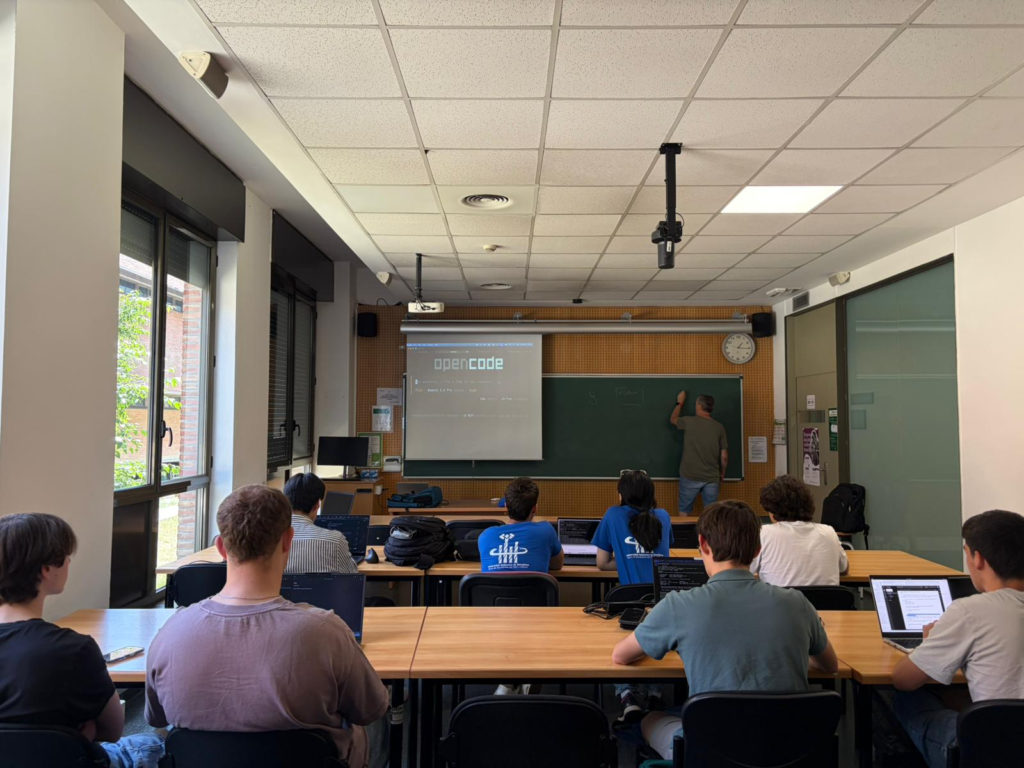
We keep adding successes in the final stretch of the semester! Last Friday, June 5th, Seminar A of the School of Engineering was once again filled with laptops, terminals, and a whole lot of curiosity. In this event hosted by the IEEE UAB x GDGoC UAB Student Branch, we set ourselves a colossal challenge: demystifying Kubernetes, Google Cloud, and seeing exactly how Artificial Intelligence is revolutionizing infrastructure.
To do this, we brought in a true global heavyweight: Viktor Farcic, Developer Advocate at Upbound, CNCF Ambassador, Docker Captain, and creator of the highly popular “DevOps Toolkit” channel.
We know that at this point in the semester, schedules are completely packed. Several of you who couldn’t attend bombarded us with messages begging us to take notes. Your wish is our command! Here is the definitive summary of a workshop that was 100% practical and incredibly eye-opening.
🕰️ The Evolution of Infrastructure: From 1990 to AI
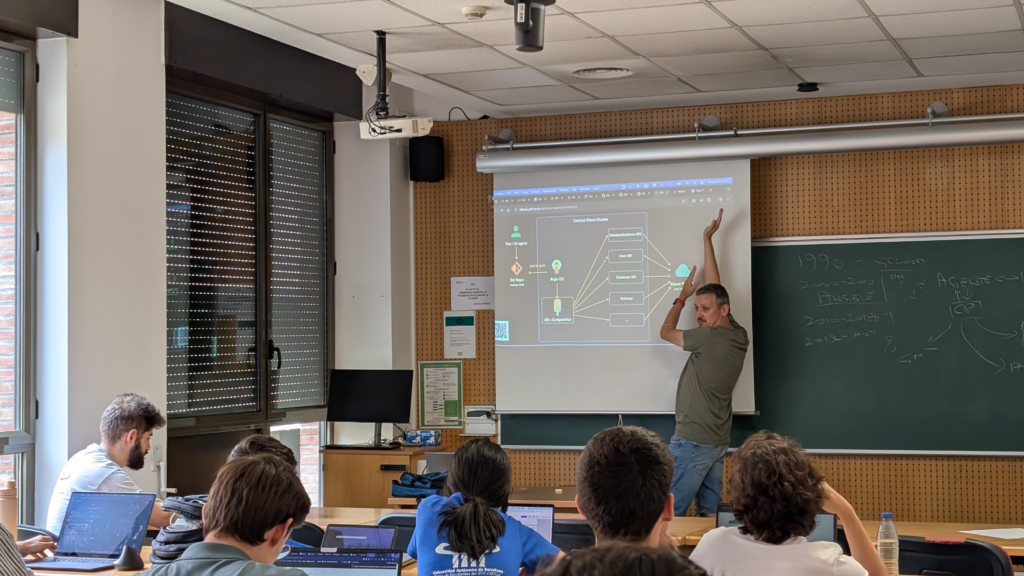
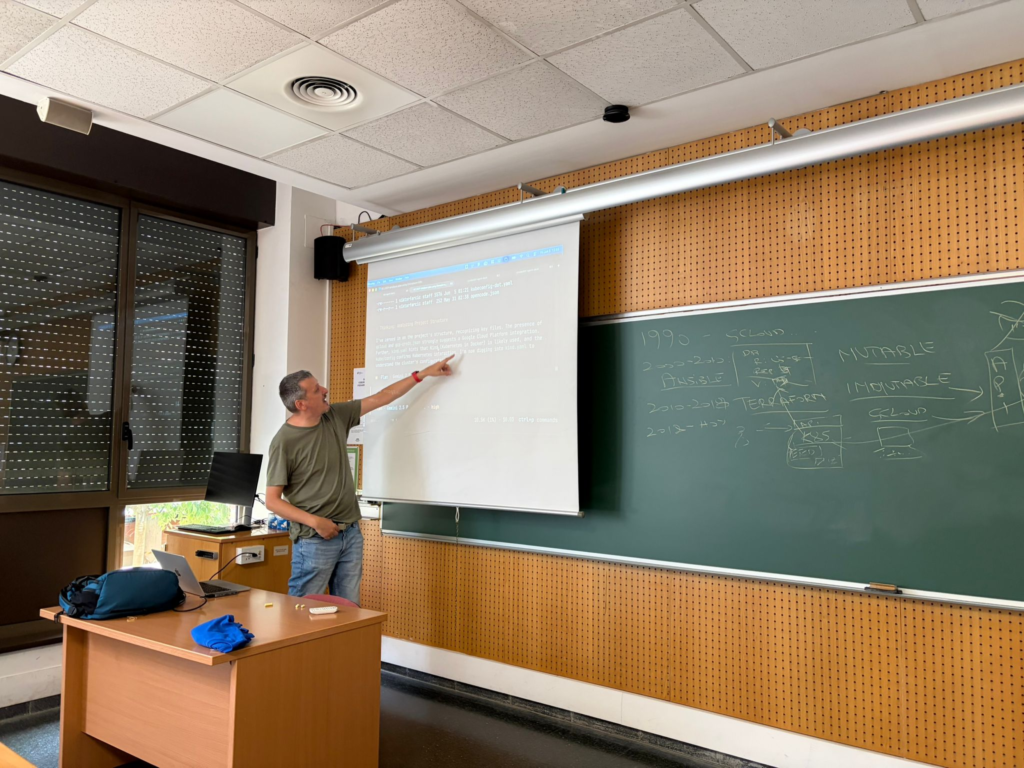
Before we started deploying resources like crazy, Viktor gave us a masterclass on how we got to this point:
- The 90s (Pure Scripting): Everything was manual. If you wanted something, you executed
gcloudcommands one by one. - 2000 – 2010 (The Declarative Era): We moved on to using tools like Ansible. We started telling the system what we wanted (“I want a Database in region X with 3 instances”) and the tool executed the specific steps to achieve it.
- 2018 – Today (Control Planes and Kubernetes): The paradigm has completely shifted. We no longer execute static scripts; instead, we have a control panel continuously observing. We define a “Desired State” and the system looks at the “Actual State”. If there are differences (drift), automatic reconciliation occurs. Kubernetes is used today for both Frontend and Backend!
And this is exactly where AI enters to change the game entirely, making everything much more dynamic and mutable.
💻 Let’s Get to Work: Our Cloud Agent in Action
To make the most of our time, we all came with our homework done: we had executed an automatic installation script in a Debian/Ubuntu environment so that all attendees started from the exact same baseline.
We connected to Google AI Studio (generating our own API Keys) and used the powerful Gemini 2.5 Pro model integrated into OpenCode. What we saw next was pure infrastructural magic:
- Agents in a Loop: We saw how the AI agent doesn’t just respond and stop, but enters an execution loop, utilizing Tools, the MCP protocol, and internet access until it successfully achieves its goal.
- Plan Mode (Zero Scares): We learned the crucial importance of “Plan Mode”. Before the AI deploys or destroys anything in production, it shows us a non-destructive plan of exactly what it’s going to do.
- Intelligent Interaction: When asking the AI to “Create a database in GCP”, instead of hallucinating or making up data, the agent asked us key follow-up questions (What type of SQL? What should we name it? In which region?). The Skills we program act as precise instructions so the AI knows exactly how to behave.
⚠️ With Great Power Comes Great Responsibility
A modern database isn’t just a simple program; it has between 20 and 30 components that must run together. The complexity today is immense. That’s why Viktor left us with a quote that is now burned into our memories:
“Just because we have an AI that can do anything doesn’t mean we can get away with not knowing what we are doing.”
A practical example of this from the workshop? If you tell the AI to configure the authorised networks with the value 0.0.0.0/0, you are basically leaving your database wide open for any machine in the world to access. Automating a disaster is very easy if you don’t understand the basics!mente estás dejando tu base de datos abierta para que cualquier máquina del mundo pueda acceder a ella. ¡Automatizar el desastre es muy fácil si no entiendes las bases!
The Numbers of the Day 📊
Another highly technical event that makes it clear that Cloud Native is going strong at UAB:
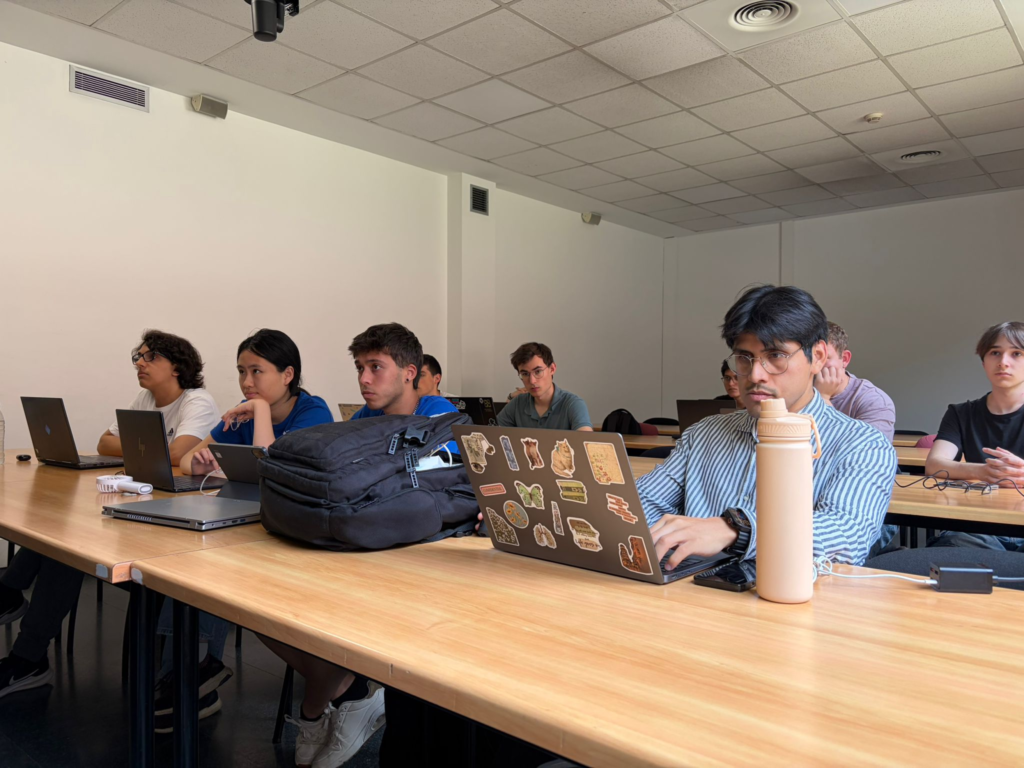
- 10 in-person attendees: All with their environments set up, experimenting live with cloud infrastructure.
- High demand for knowledge: This summary is specifically for all of you who personally asked us for the notes!
- High-voltage networking: Learning from the mistakes and successes of real architecture design with a global expert is a luxury that doesn’t happen every day.
What’s Next?
With this workshop, we wrapped up the technical events of the semester. Following our Roadmap, we just held our last meetup before the summer:
- Final Study Session (June 8th): Our 10th official event of the academic year. We opened the doors for our traditional “Study Sprint”—featuring coffee, cookies, a great atmosphere, and group studying to crush the final exams.
Want to be part of the change and not miss out on what we are preparing for next year? Sign up for free as a member, follow us on Instagram (@ieee_uab) and join the revolution.
Good luck with finals and see you next time! 🚀
The IEEE Student Branch UAB x GDGoC UAB Team